
From Attention to Revenue, JBE Digital Wants the Whole Story
Digital marketing has become wonderfully precise about the parts. A business can know what it paid for a click, which keyword produced it, how long the visitor stayed, what advert they saw beforehand and whether they eventually filled in a form. Dashboards glow with activity, platforms return percentages to two decimal places and every channel arrives with its own vocabulary for proving progress. The difficulty begins when somebody leaves the marketing meeting and asks the question the finance director actually cares about: what did all of it do to revenue? Australia’s advertising industry is confronting much the same problem. IAB Australia’s latest measurement review found confidence remains comparatively strong within individual channels but weakens when marketers try to understand their collective business impact. An industry built on the promise of measurability has accumulated extraordinary amounts of information without necessarily making the whole easier to see.
JBE Digital starts from the other end of that calculation. Before deciding how much should go into Google Ads, SEO, paid social or anything newer, the Melbourne performance agency defines the commercial numbers the engagement is supposed to change: cost per lead, customer acquisition cost, pipeline contribution and revenue. Tracking and attribution are inspected before campaigns begin; media, search, content and conversion are then organised around a proprietary framework it calls the Trust Engine rather than treated as separate pieces of work. It is a deceptively simple inversion. Instead of asking each marketing channel to perform well on its own terms, JBE asks what happens when all of them are made answerable to the same business outcome.
The Dashboard Is Not the Business
That distinction becomes important because marketing metrics are useful precisely until they are mistaken for commercial results. A cheaper lead may be progress, unless the sales team discovers that fewer of those leads can buy. More organic traffic looks encouraging, unless the people arriving have little relationship with the product being sold. A rising click-through rate can reward an excellent advert without saying anything about whether the customer it attracts is worth acquiring.
JBE’s answer is to establish accountability before activity. Its own material repeatedly returns to cost per lead, acquisition cost, pipeline and revenue, while client selection forms part of the same discipline. The agency says it works best with established businesses that already possess revenue, people and the operational capacity to absorb growth. That filter is more consequential than it first appears. Performance marketing can accelerate a functioning commercial model; it is considerably less useful when asked to compensate for a weak proposition, poor sales process or business unable to handle the demand it generates.
Sometimes, in other words, marketing is not the thing that is broken. An agency willing to recognise that becomes more credible when it says marketing can help.
When the Channels Stop Adding Up
The next difficulty is that customers show little respect for organisational charts. A buyer might discover a company through Google, encounter it again on social media, read an article several days later, look for reviews, return through branded search and eventually convert through a landing page. Each specialist can produce a report explaining their part of that journey. The customer experienced only one decision.
That is where JBE’s Trust Engine becomes more than a convenient name for service breadth. Paid media, search visibility, content, conversion environments and tracking are intended to reinforce one another, with optimisation taking place against the commercial measures established at the beginning. The underlying argument is that independent channel optimisation eventually reaches a ceiling because the effectiveness of one part increasingly depends on what happened before and what happens afterwards.
Its work with Pacific Airshow gives the idea some substance. Before expanding the paid campaign, JBE audited shortcomings in the existing tracking and optimisation setup, then built the work around ticket sales rather than media activity alone. The campaign subsequently delivered roughly 20 per cent year-on-year ticket-sales growth and a reported 19-times return on ad spend. The important sequence is not advert, click, sale. It is measurement, understanding, execution, consequence. Better media became possible because the agency first became more certain about what the media was being asked to achieve.
Trust in an Age of Infinite Content
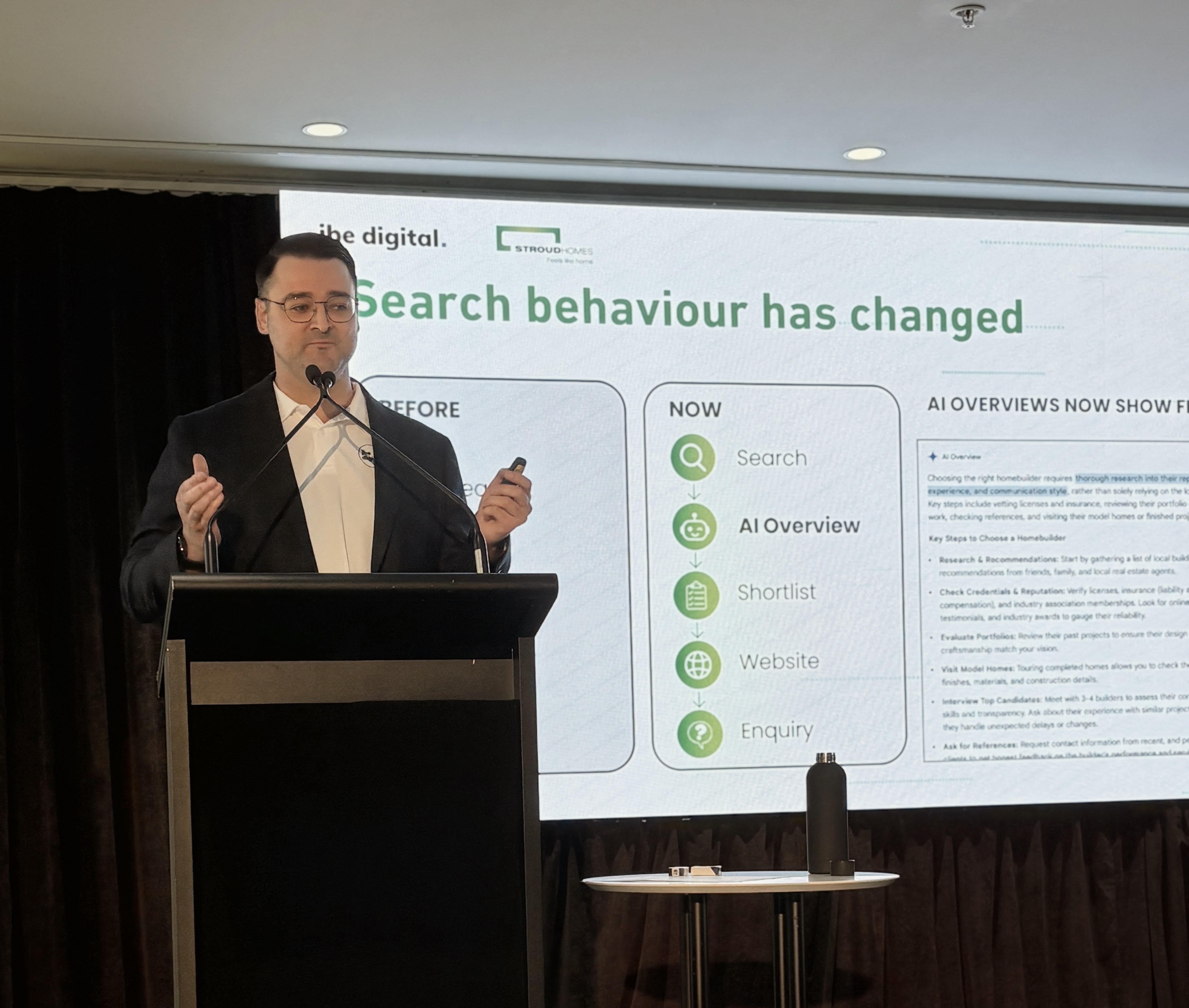
The arrival of generative AI complicates that journey again. Search is becoming more conversational, content production is becoming cheaper and polished information is becoming easier for almost any company to manufacture. Google says AI Mode has surpassed one billion monthly users globally, with people using it to ask longer and more exploratory questions than they typically submit through traditional search. Businesses therefore face an odd new abundance: more ways to be discovered, more ways to publish and potentially more difficulty distinguishing genuine authority from competence produced at scale.
Trust begins to look less like a brand adjective and more like part of conversion infrastructure. Being found is useful; being believed is what allows discovery to travel towards action. That helps explain why JBE places search, content, conversion and measurement inside the same system rather than regarding visibility as the finish line.
Its campaign for ASA Cultural Tours illustrates the slower side of that process. Across a 16-month SEO programme, the agency mapped more than 600 search terms, reworked technical and content foundations and grew non-branded organic traffic by a reported 129 per cent year on year, alongside substantial gains in top-ranking keywords. There is very little instant about work like that. Authority accumulates through repeated evidence that a business deserves to appear when a prospective customer begins asking serious questions.
That body of work has also begun attracting recognition beyond the client account. JBE was shortlisted at the Global Search Awards 2026 for Best Use of Search – Travel/Leisure (SEO) and the APAC Search Awards 2026 for Best PPC Campaign, having won TechBehemoths Awards in 2025 for both SEO and UX/UI Design. The significance is less the accumulation of trophies than the range they cover. Search, paid media and conversion design are usually judged as separate disciplines; JBE’s argument is that their commercial value becomes more interesting when they stop behaving like separate ones.
The New Channel, the Old Question
AI search and conversational advertising are now adding still more places for that decision to happen. OpenAI expanded access to ChatGPT advertising in May 2026, introducing CPC bidding and a beta self-service Ads Manager as the platform broadened its advertising pilot. JBE says it began running live campaigns on the platform during the early rollout and is investing more heavily in AI-search visibility, answer-engine optimisation and measurement.
The novelty is real, but novelty is not yet a commercial argument. Every emerging channel eventually produces its own dashboard, vocabulary and promises of advantage. The harder discipline is refusing to let a new metric become valuable merely because it is newly measurable.
That is why JBE’s plan to formalise the Trust Engine as a diagnostic is potentially more important than the arrival of any single platform. The framework is intended to show businesses where growth is leaking before prescribing what should be added next. As marketing becomes more fragmented, that ability to diagnose the system may matter more than simply extending the list of channels an agency can operate.
There will be more platforms, more signals and considerably more data. The dashboard will become more detailed. JBE Digital’s wager is that none of this is especially useful unless somebody can still draw a line from all that activity to a customer, a pipeline and, eventually, the business itself.